
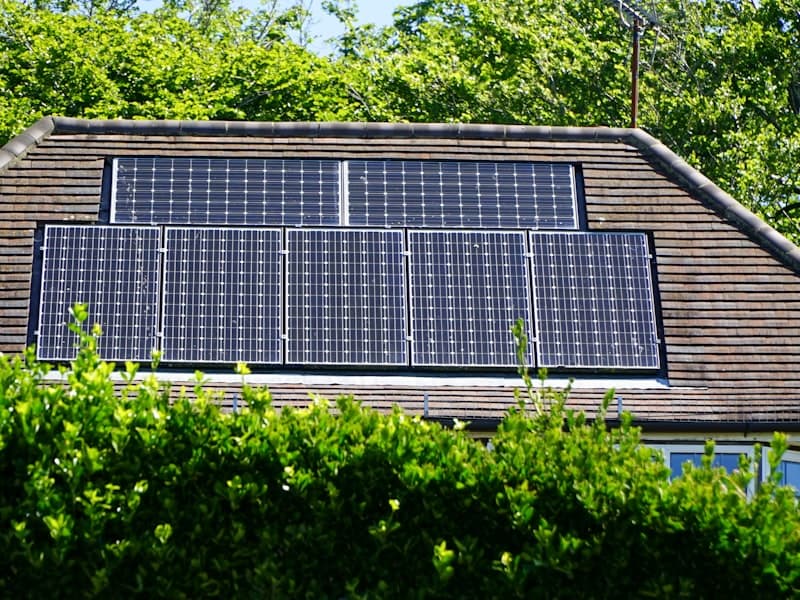
Solar panels: what you actually need to know
Sunlight hits your roof. You get electricity. That's genuinely the idea.
Solar panels turn sunlight into electricity you can use in your home. Not heat (that's solar thermal, different thing). Electricity. The same stuff that comes out of your sockets.
When the sun is shining, your panels generate electricity. Your home uses it first. Anything left over either goes into a battery (if you have one) or gets exported to the grid, and you get paid for it.
How they work, in three steps
Sunlight hits the panels
Each panel contains photovoltaic (PV) cells, layers of silicon that release electrons when light hits them. That flow of electrons is electricity. It works with daylight, not just direct sunshine.
Inverter converts the power
The panels produce direct current (DC). Your home runs on alternating current (AC). A box called an inverter, usually mounted on the wall near your fuse board, makes the conversion.
Your home uses it (or exports it)
Your appliances use the solar electricity first. Any surplus flows to the grid, and your energy supplier pays you for it via the Smart Export Guarantee. If you have a battery, surplus charges that instead.
“But it's always cloudy in the UK”
This is the number one objection, and it's completely understandable. But it's wrong.
Solar panels work on daylight, not direct sunshine. Even on an overcast day, they still generate, just less. The UK gets enough solar radiation for panels to pay for themselves comfortably. Germany, which gets similar sunlight levels, has four times more solar capacity than us.
2025 was a record year for UK solar generation. The technology has got dramatically better at working in lower light. Modern panels produce meaningful electricity even on grey January days.
3,400+
kWh/year
Typical 4kW system, south-facing
2,700+
kWh/year
Same system, east or west-facing
Three types, one recommendation
Roof-mounted panels (the standard choice)
Panels bolted to a frame on your existing roof. This is what 90%+ of UK homes get. Cheapest per watt, well-proven, usually doesn't need planning permission. This is what we're mostly talking about.
Ground-mounted
Panels on a frame in your garden. Good if your roof isn't suitable (wrong angle, too shaded) but you have the space. Costs more and usually needs planning permission.
Solar tiles
Tiles that replace your roof covering and generate electricity. Look sleek, but cost 2–3× more than standard panels for the same output. Worth considering if you're re-roofing anyway, otherwise hard to justify.
What a typical system looks like
Most homes get a 3–4kW system. That's about 8–10 panels on your roof, covering roughly 15–20m² (a little less than a single parking space).
Typical 3.5kW system
- Panels
- 8–10 panels(~400W each)
- Roof space needed
- ~15–20m²
- Annual generation
- ~3,000–3,500 kWh
- Household electricity use
- ~2,700 kWh/yr(UK average)
- Self-consumption
- ~30–50%(without battery)
- Self-consumption
- ~60–80%(with battery)
Generation depends on roof orientation, angle, shading, and location. South-facing roofs at 30–40° produce the most.
What it costs
Panels only
£5,000–£7,000
Typical 3–4kW system
With battery
£7,500–£11,500
Battery adds £2,500–£4,500
Solar panels have no VAT (0% until at least March 2027). Prices have dropped dramatically, a system that cost £12,000 ten years ago now costs half that.
The Warm Homes Plan is introducing zero-interest loans for solar panels from 2026, making the upfront cost even more manageable. Check eligibility when the scheme launches.
When you break even
Most systems pay for themselves in 8–11 years. After that, the electricity is effectively free for another 15–20 years (panels are warranted for 25 years and often last 30+).
Payback example (3.5kW system, no battery)
- System cost
- £6,000
- Annual electricity saving
- ~£450–£550(at current rates)
- Annual export income
- ~£80–£120(Smart Export Guarantee)
- Total annual benefit
- ~£550–£650
- Payback period
- ~9–11 years
- 25-year net benefit
- ~£8,000–£10,000
Based on Ofgem Q1 2026 cap rates. Rising electricity prices shorten the payback. A battery increases self-consumption but also increases the upfront cost.
Getting paid for surplus: the Smart Export Guarantee
When your panels generate more than you're using, the surplus goes to the grid. Under the Smart Export Guarantee (SEG), your energy supplier must offer you a rate for this exported electricity.
Rates vary by supplier, typically 4–15p per kWh. Some offer “agile” tariffs where you earn more at peak times. It's not life-changing money (maybe £80–£150/year), but it's a nice bonus on top of the savings on your own bill.
You need a smart meter and an MCS-certified installation to qualify. Your installer can help you sign up.
Battery storage: worth it?
Without a battery, you use solar electricity only when the sun is shining. If you're at work all day, a lot of your generation gets exported for 5–15p when you could have been using it instead of buying at 27.69p.
A battery stores surplus daytime generation so you can use it in the evening. A typical home battery (5–10kWh) costs £2,500–£4,500 and boosts self-consumption from ~30% to ~60–80%. See our solar battery guide for the full breakdown on when batteries make financial sense.
Good case for a battery: You're out during the day, you have a time-of-use tariff, or you want backup power during outages
Weaker case: You're home during the day and use electricity as it's generated, or the budget is tight, panels alone give the best return per pound
If budget is a concern, start with panels only. You can always add a battery later, the wiring is usually designed to allow this.
Planning permission
Usually not needed. Roof-mounted solar panels are “permitted development” in England, meaning you can install them without applying for planning permission, as long as they don't protrude more than 200mm from the roof surface and don't face a highway on a listed building.
No permission needed: Most roof-mounted panels on houses
Check first: Listed buildings, conservation areas, flats, ground-mounted arrays over 9m²
Is solar right for your home?
Good candidate: South, south-east, or south-west facing roof with minimal shading, reasonably modern roof in good condition, own the property (not renting)
Possible but lower output: East or west-facing roof (still generates ~80% of south-facing), partial shading from trees or buildings, smaller roof area
Harder: North-facing roof only, heavy shading all day, flat or leaseholder (need freeholder permission), roof needs replacing first
Your installer must be MCS-certified. This is required for the Smart Export Guarantee and any government incentive schemes. MCS certification means the system is designed and installed to a recognised standard: it's your quality guarantee.
Get quotes
Project Solar
Solar PV specialists · 50,000+ UK homes
OVO Solar & Heating
Solar panels and battery storage · Free survey
Glow Green
Solar + battery storage · MCS certified
Blue Ape Renewables
Solar + renewables · Free survey
MCS Installer Finder
Search any MCS-certified solar installer near you
We may earn a commission from some links. This doesn't affect our recommendations or your price. Affiliate disclosure
See what the data says about your home
We show your EPC rating, solar potential, and local installation data, based on government records for your property.
Enter your postcode