
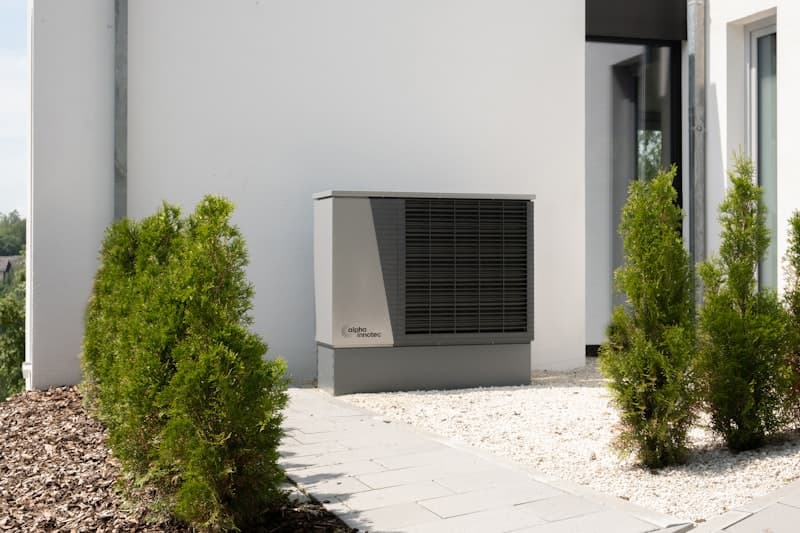
What is a heat pump?
A fridge, but backwards. That's genuinely it.
Your fridge pulls heat out of food and dumps it into your kitchen (feel the warm air coming off the back). A heat pump does the same thing in reverse: it pulls heat out of the outdoor air and pumps it into your house.
Yes, even when it's cold outside. There's usable heat in air all the way down to about −25°C. The UK rarely drops below −5°C.
How it works, in four steps
Fan draws in outdoor air
An outdoor unit (about the size of a washing machine) pulls air across a heat exchanger containing refrigerant.
Refrigerant absorbs heat
The refrigerant, a special fluid with a very low boiling point, evaporates, absorbing heat energy from the air even at low temperatures.
Compressor raises the temperature
An electric compressor squeezes the gas, which raises its temperature significantly. This is the step that uses electricity.
Heat transfers to your home
The hot refrigerant passes through a heat exchanger inside your home, heating the water in your radiators, underfloor heating, or hot water cylinder. Same radiators you have now.
The cycle then repeats. The refrigerant cools down, flows back outside, and absorbs more heat. It runs continuously at a low level rather than blasting on and off like a boiler.
Why people say they're 300% efficient
A gas boiler burns gas to make heat. Best case, you get 90p of heat for every £1 of gas. The other 10p goes up the flue.
A heat pump doesn't make heat, it moves it. For every £1 of electricity it uses to run the compressor, it moves £2.50–£3.50 of heat energy into your home. The rest comes free from the air.
90%
Gas boiler efficiency
£1 gas → 90p heat
300%+
Heat pump efficiency
£1 electric → £3 heat
This ratio is called the Coefficient of Performance (COP). A COP of 3 means 3 units of heat for 1 unit of electricity. In practice, real-world UK seasonal averages (SCOP) range from 2.5 to 3.8 depending on the system, the home, and the weather.
“But electricity costs more than gas”
Yes it does. About 4.3 times more right now (24.67p vs 5.74p per kWh). This is the objection everyone raises, and it's the right one to raise.
A heat pump is about 3x more efficient than a gas boiler. So even though electricity costs 4.3x more per unit, you use 3x fewer units. That means heat pump running costs are slightly higher than gas right now, roughly £100-200 more per year for a typical home. But three things change the picture: the £7,500 grant pays for itself many times over, gas prices are forecast to rise, and the government plans to shift green levies from electricity bills to gas, which would close the gap further.
Running cost comparison (typical 3-bed house)
- Gas boiler
- ~£700–£900/yr(85% efficient)
- Heat pump
- ~£800–£1,100/yr(COP 3.0)
- Heat pump + solar
- ~£400–£600/yr(offsetting electricity)
Based on Ofgem Q2 2026 cap rates. Actual costs depend on home size, insulation level, and usage patterns.
The government is also planning to shift green levies from electricity bills to gas bills or general taxation, which would widen the gap in the heat pump's favour. This was signalled in the Warm Homes Plan.
What you actually get installed
What it costs
Before grant
£8,000–£15,000
Avg ~£12,000
After BUS grant
£500–£7,500
Avg ~£4,500
The £7,500 Boiler Upgrade Scheme grant is deducted from the installer's invoice, you never pay the full amount. The installer handles the paperwork.
A new gas boiler costs £1,500–£3,500 installed. So after the grant, a heat pump can cost a similar amount, sometimes less, while running cheaper for the next 15–20 years.
Honest answers to common worries
“They don't work in cold weather”
Modern heat pumps work down to −25°C. The UK record low is −27°C (1982, Scotland). Typical UK winters rarely drop below −5°C. Scandinavian countries with far colder climates install more heat pumps per capita than the UK. This concern is outdated, it applied to early models from 15+ years ago.
“They're noisy”
About 40 decibels at 1 metre, similar to a fridge or a quiet conversation. Your gas boiler is about the same. There are planning rules on placement (1 metre from a boundary), but noise complaints are rare with modern units.
“My house is too old”
Heat pumps work in old houses. They work better in well-insulated houses, but that's true of gas boilers too. If your home is poorly insulated, the priority is insulating first. Many Victorian and Edwardian homes have had heat pumps successfully installed. The key is getting the system properly sized by a competent installer.
“I need underfloor heating”
No. Heat pumps work with radiators. They run at lower flow temperatures than boilers (typically 35–45°C vs 60–80°C), so some radiators may need upsizing. But most homes don't need to replace every radiator, a good installer will assess what's needed.
“The grant will disappear”
Possibly. The £7,500 BUS grant is currently funded through March 2028. The Warm Homes Plan commits to continued support, but the amount could change. If you're thinking about it, the case for acting while the grant exists is stronger than waiting to see.
Three types, one recommendation
Air-to-water (the main one)
Takes heat from air, heats water for radiators and hot water. This is what 95% of UK installations are. This is what the £7,500 grant covers. This is what we're mostly talking about.
Air-to-air
Takes heat from air, blows warm air directly into rooms (like air conditioning in reverse, because that's literally what it is). Cheaper to install, no radiators needed, but doesn't heat water. Eligible for a £2,500 BUS grant (not £7,500). Also included in the Warm Homes Plan.
Ground source
Pulls heat from underground via buried pipes. More efficient than air source (the ground is a more stable temperature), but costs £20,000–£30,000 and needs space to dig. The £7,500 grant applies here too, but it's less common.
Is a heat pump right for your home?
The short answer: probably, but insulate first. The longer answer depends on your house:
Good candidate: Detached or semi-detached, some insulation already done, space outside for the unit, hot water cylinder (or space for one), radiators that aren't tiny
Possible but needs thought: Terraced house (space for outdoor unit?), listed building (planning), combi boiler home (needs cylinder added), very poorly insulated
Harder: Flat without ground-floor access, no space for outdoor unit, shared heating system
The best first step is getting a proper assessment from an MCS-certified installer. They'll survey your home, size the system, and tell you what (if anything) needs upgrading first. Many offer free surveys.
Get quotes
Glow Green
Air source heat pumps · MCS certified
OVO Solar & Heating
Air source + ground source heat pumps · Free survey
Blue Ape Renewables
Air source heat pumps · Free survey
MCS Installer Finder
Search any MCS-certified heat pump installer · Required for BUS grant
We may earn a commission from some links. This doesn't affect our recommendations or your price. Affiliate disclosure
See what the data says about your home
We show your EPC rating, heating system, and whether your property is a good fit, based on government data.
Enter your postcode